
7 Days Mt. Kilimanjaro Marangu Route
Kilimanjaro
Trek overview
7 Days Mt. Kilimanjaro Marangu Route
Route Overview
The Marangu Route is the one route on Kilimanjaro where you sleep in huts rather than tents: Mandara, Horombo and Kibo huts. It goes up and comes back down the same trail from Marangu Gate, on the south-east side of the mountain.
The first day climbs through montane rain forest to Mandara Hut (2,715 m). The next skirts Maundi Crater, worth a short detour for your first clear view of Kibo, and crosses into moorland of giant lobelias and groundsels to Horombo Hut (3,705 m).
This seven-day version adds a second night at Horombo to acclimatise, with a recommended hike towards Mawenzi Hut past the Zebra Rocks. From there you cross the alpine desert of the Saddle to Kibo Hut (4,730 m), set off around midnight for Gillman's Point and Uhuru Peak (5,895 m), and come back down to Horombo the same day. The last day walks down to Marangu Gate, where summit certificates are handed out.
Prefer six days? See the 6 Days Marangu Route.
Day by day
7 Days, Step by Step
-
You will be picked up by our team from Kilimanjaro International Airport (JRO) and driven to your accommodation in Moshi. Participants will be given a short briefing for the climb the next day. Kits and the necessary equipment will be checked as well.
- Half board
-
Hiking time: 5hrs •Distance: Approximately 8.1 km • Habitat: Montane forest
The drive from Moshi to the Kilimanjaro National Park gate takes about 50 minutes. The journey passes through the village of Marangu, which is located on the lower slopes of the mountain. Once you reach the park gate, all hikers are requested to sign in at the Park office and make their final preparations for the climb. Porters will be seen arranging and loading their packs, containing the food, water, cooking gas as well as most of your equipment.
From the park gate, we ascend on a cleared ridge trail through the rain forest where you will see most of Kilimanjaro’s animals. An alternative and more scenic parallel forest trail branches off to the left a few minutes after the gate. This trail follows the edge of a stream through the undergrowth and offers you the option to rejoin the main trail either after 1.5 hours hiking, or 1 hour before Mandara hut where you will spend the night.
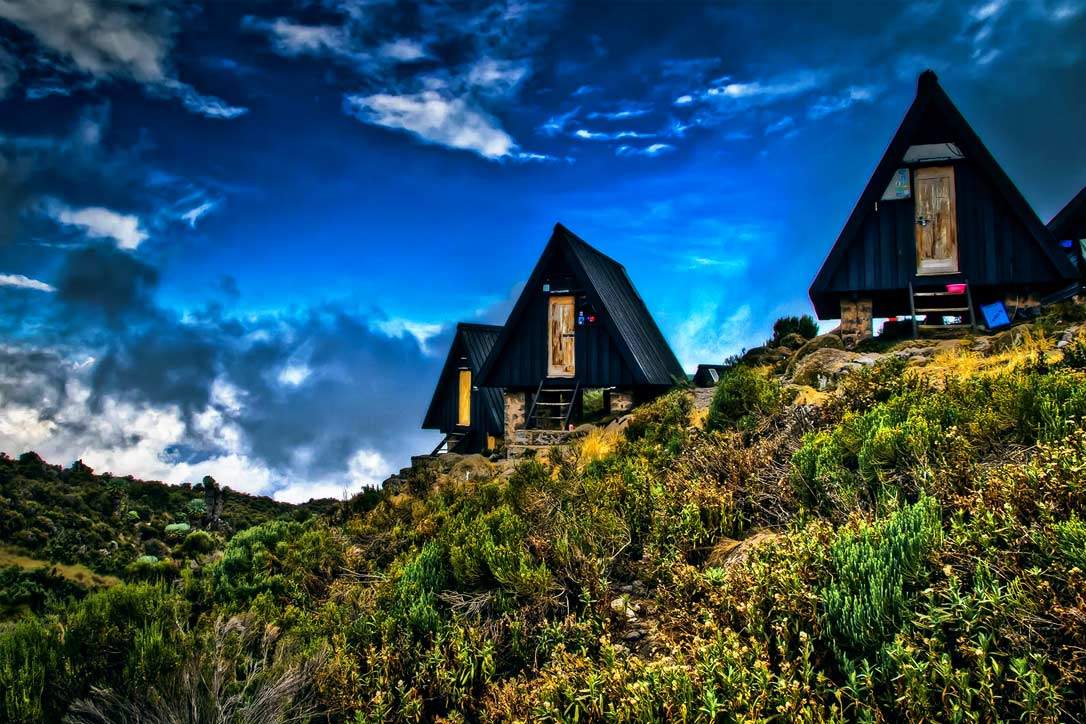
Mandara hut consists of a group of wooden A-framed huts in a forest clearing. Each hut features 6-8 sleeping bunks with solar-generated lighting. The total capacity of the camp is 60 climbers. Water is piped into the camp from springs above and there are flush toilets behind the main hut.
- Full board
- 5 hrs
- 8.1 km
- Montane forest
-
Hiking time: 6hours •Distance: Approximately 11.6 km •Habitat: Moorland
From Mandara hut, the trail passes through a short stretch of forest, skirts the base of the Maundi Crater, and then emerges into a transition from rainforest to moorland. It is well worth a short detour to scramble up the rim of the Maundi Crater for your first impressive view of the Kibo Crater. On a clear day, Kibo will glimmer in the distance, with sightings of majestic glaciers in the morning sun.
Once you are in the open moorland, you will get the chance to see some of Kilimanjaro’s most spectacular plants – the endemic giant lobelia which grows up to 3 m in height, and the giant groundsel (Seneca Kilimanjaro), which can reach heights of 5m. After about 6 hours’ trek from here, you reach the Horombo hut for your accommodation.
- Full board
- 6 hours
- 11.6 km
- Moorland
-
Horombo hut is a village of huts perched on a small plateau, with buildings similar to Mandara with a capacity of 120 climbers! Horombo is normally bustling with hikers, guides, and porters, with an atmosphere of adventure and excitement. You will meet both ascending and descending hikers here. This extra day and night at Horombo is for additional acclimatization. A hike towards the Mawenzi hut, passing the Zebra Rocks on the way (about 3 hours up and 1,5 hours down) is strongly recommended.
- Full board
-
Hiking time: 6hours •Distance: Approximately 9.6 km •Habitat: Alpine desert
After breakfast, we continue our ascent into the Alpine desert habitat. From Horombo, there are two trails to the “Saddle” (which refers to the area located between the peaks of Mawenzi and Kibo). There is an upper route (right-hand fork) and a lower route (left-hand fork) to choose from. The upper route should be very familiar, as you will have climbed most of it the previous day towards Mawenzi hut. This section is very stony and eroded.
The recommended lower route (left-hand fork) is much easier and nearly an hour shorter, and it also passes the last watering point at 4130m. You will have to fill your water bottles with all the water you will need until your return to Horombo hut in two nights’ time (unless you are willing to buy Mineral water at Kibo hut).
Situated in the barren Alpine desert is Kibo hut, a stone build block house that has bunk beds for 60 climbers, but no streams with water nearby. It is however possible to buy mineral water and soft drinks at the camp office. There are platform toilets behind the hut.
The summit is now a further 1195m up and you will make your final ascent the same night. Prepare your equipment, ski stick, and thermal clothing for your summit bid. This should include the replacement of your headlamp and camera batteries and make sure you have a spare set available as well. To prevent freezing, it will be wise to carry your water in a thermal flask.
- Full board
- 6 hours
- 9.6 km
- Alpine desert
-
Hiking time: 7 to 8 hours to reach Uhuru Peak | 6 to 8 hours to descend to Horombo Distance: Approximately 5.4km ascent and 15 km descent •Habitat: Stone scree and ice-capped summit
You will rise around 23h20, and after some tea and biscuits you shuffle off into the night, and this is where the going really gets tough. The first section of the trail consists of a rocky path to the Hans Meyer Cave (5150m) and also offers a good resting spot. The path then zigzags up to Gillman’s point (5 681m), which is located on the crater rim. This section is very steep with a lot of stone scree, requiring great physical and mental effort. This is probably the most demanding section of the entire route. Do the Kili shuffle and move slowly.
From Gillmans Point, you will normally encounter snow all the way up to Uhuru Peak (5895m), the highest point in Africa. Weather conditions on the summit will determine how long you will be able to spend, taking photographs, before the 3-hour descent back to Kibo hut. After a short rest, you gather all the gear you left behind for the ascent and head down to Horombo hut (3 hours) for your overnight. The return to Horombo hut will seem surprisingly fast compared to the ascent. The total time spent walking on this day is around 14 hours, so be prepared for a very tough day. Later in the evening, you will have your last dinner on the mountain and have your well-earned sleep.
- Full board
- 5.4 km
- Stone scree and
-
Hiking time: 6 hours •Distance: Approximately 19.7 km
After breakfast, you continue your descent (6 hours), passing the Mandara hut, down to the Marangu gate. At Marangu Gate, you will receive your summit certificates. Those climbers who reached Gillman’s Point (5685m) are issued with green certificates and those who reached Uhuru Peak (5895m), receive gold certificates. You now drive back to Moshi/ Arusha for a long overdue hot shower, dinner, and celebration.
- Full board
- 6 hours
- 19.7 km
Transparent pricing
What This Trek Costs
Prices are per person sharing for this 7-day / 6-night trek. What the price covers is listed under What’s Included.
| Season | Solo | 2 guests | 4 guests | 6+ guests |
|---|---|---|---|---|
| Low season 1 March – 31 May The long rains. Lowest prices. | $3,800 | $2,540 | $2,230 | $2,100 |
| High season 1 November – 20 December, 6 January – 29 February Dry and green in turn. | $4,000 | $2,670 | $2,350 | $2,220 |
| Peak season 1 June – 31 October, 21 December – 5 January The driest months. Book well ahead. | $4,440 | $2,970 | $2,610 | $2,460 |
All prices are per person sharing, in USD.
Final quotes depend on season and group size — tell us your dates and we’ll confirm exact pricing free of charge.
The fine print, upfront
What's Included
Included
- Park fees
- All activities (unless labeled as optional)
- All accommodations as stated in the itinerary
- A professional driver/guide
- All transportation (unless labeled as optional)
- All Taxes/VAT
- Roundtrip airport transfer
- All Meals (as specified in the day-by-day section)
- Camping Equipment
- Porterage
Not included
- International flights (from/to home)
- Additional accommodation before and at the end of the tour
- Tips (tipping guideline US$20.00 pp per day)
- Personal items (souvenirs, travel insurance, visa fees, etc.)
- Government imposed increase of taxes and/or park fees
- Alcohol drinks
- Rescue Fee
- Climbing Gear
- Sleeping Bag


Kiki / Aug 2026
A truly unforgettable trip, the local tour guide was very responsible!
Overall, our trip to Kenya was fantastic. The itinerary was excellent, and they handled a few hotel issues very promptly and efficiently. Our…
Yixin D
Lappet Faced Safari Forever!
Francisco and his team have done a very good job. Francisco has arranged everything in Tanzania and kept an eye on our trip. Francisco's response speed is very fast. He arranged a photographer for our Safari The photographer recorded all the animals we saw and the wonderful moments. Our driver Noel is like my big brother. He has eagle eyes and finds animals at any time. He knows time management, and we have nothing to worry about with him. We saw rhinoceros and even baby rhinoceros six times in Ngorongoro, and on the third day we had seen all the Big Five and their babys.This is a Great Safari.Francisco and his team are very reliable. We paid the full amount when we were in China. Francisco completed all our hotel reservation requirements and sent us a hotel reservation form.Francisco is very honest. Their profits are not high, but they take their customers very seriously, even if their company is small.Their prices are detailed and transparent, and all details will be sent. Choosing them will make you have an unforgettable trip!弗朗西斯科和他的团队非常好,弗朗西斯科为我们安排好了一切,所有酒店没有任何更改,他安排了摄影师记录了我们的游猎时光,我们在第三天的时候已经看到了Big Five 和他们的babys.
xiang / Jul 2026
A very reliable travel agency
Driving an off-road vehicle bumpily on the vast grassland, the dust raised seems to be a filter of time, instantly pulling people back to the…
philo04
Wonderful Safari experience with Myk as our guide
We did a custom made safari tour for seven nights in Tanzania using the guide Myk Walcott from this company. It was an amazing experience. Myk is a fantastic guide, he is calm, supportive, knowledgeable, is a very safe driver, and is an excellent game driver, he tended to our every need. We stayed in four different hotels and all were excellent, the good was excellent, every detail was well organized. We had fantastic packed lunches on the go, we always had cold bottled water at our disposal. We felt very safe and like we were in good hands. We highly recommend this safari company and especially Myk as your guide. He went above and beyond for us, taking us to a local market in Arusha per our request and we even stopped at a local orphange to drop off supplies near the Tarangire National Park which was a wonderful experience. We only wish we could have stayed for longer and we hope to return in the future. Highly recommended
Robin / Jun 2026
A breathtaking, memorable voyage of dreams
This long-awaited trip required last-minute schedule changes mid-way due to illness and unavoidable flight disruptions, yet the Lappet Faced…
Amanda A
7 day awesome safari
We had the best time ever on the 7 day safari (Tarangire, Serengeti and Ngorongoro). Eric organized everything perfectly and was always available when needed. You can trust him on organizing your safari with your eyes closed!Our guide Noeli was amazing, he has a lot of experience as a safari guide and has vast knowledge on animals, plants, ecosystems, the culture.. He was able to answer our questions. He spotted so many animals and birds for us, and was very patient while we photographed everything. We even got to see the honey badger!! We really recommend going with Noeli, thanks a lot again for taking us to those beautiful places.I really recommend this tour company and would definitely do it again!
Let's plan together
Ready to Experience Tanzania?
Tell us your dates and dreams — our Arusha team will craft a private itinerary within 24 hours.
