
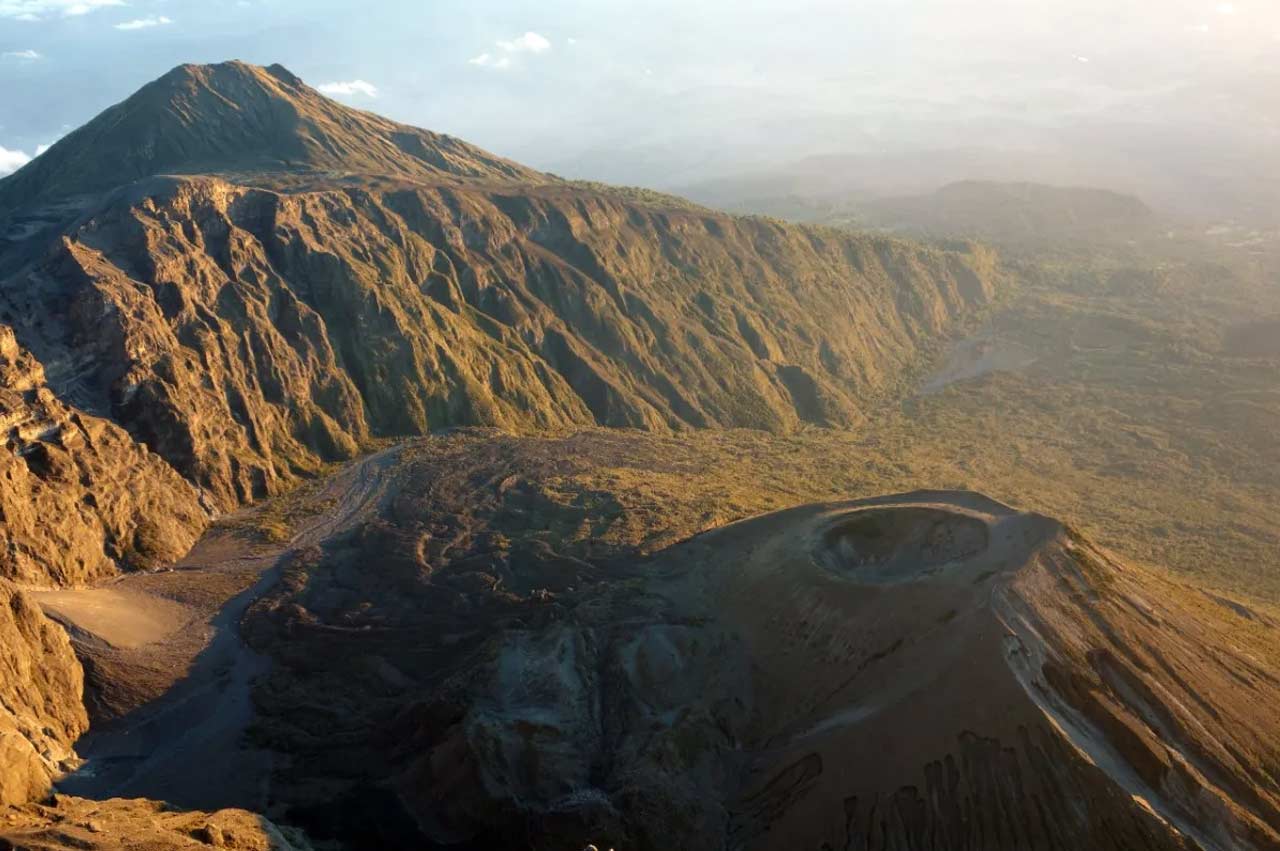
The mountain above Arusha
Mount Meru
A dormant volcano rising straight out of Arusha National Park, and the view Kilimanjaro climbers wake up to on the far side.
- 4,566m
- Arusha National Park
- Climbed in three or four days
The other mountain
Mount Meru: Tanzania's Underrated Summit
Mount Meru stands at 4,566 metres, the second-highest mountain in Tanzania and the fifth-highest in Africa, and it sits directly above Arusha — close enough that most visitors to the northern circuit look at it every day without knowing what it is. It is an active stratovolcano whose eastern wall collapsed in a colossal eruption, leaving a horseshoe crater with a near-vertical inner cliff and an ash cone on the floor.
That collapsed shape is what makes the climb extraordinary. The summit ridge is a narrow rim above a 1,500-metre drop into the crater, and the final approach along it at sunrise, with Kilimanjaro floating above the cloud fifty miles to the east, is one of the great mountain views in Africa.
Meru sits inside Arusha National Park, so the lower slopes are full of wildlife. An armed ranger accompanies every group — not ceremonially, but because you walk through buffalo and elephant country on the first day, and giraffe and colobus monkeys are routine along the trail.
The numbers
Mount Meru at a Glance
- 4,566 m
- Socialist PeakThe summit — Tanzania's second-highest point, and Africa's fifth.
- 3 – 4 days
- Typical trekThree days is standard; four adds an acclimatisation day and makes it far more comfortable.
- 2
- Mountain hutsMiriakamba and Saddle Huts — bunk accommodation, so no tents required.
- ~1 hour
- From ArushaThe Momella gate is a short drive from town, with no long approach.
The route
How the Climb Unfolds
-
1
Day 1 — Momella Gate to Miriakamba Hut
Around four to five hours through montane forest with an armed ranger. Buffalo, giraffe, warthog and black-and-white colobus are all common on this stretch, and the walking is gentle.
-
2
Day 2 — Miriakamba to Saddle Hut
A steeper three to four hours up through heath and giant heather to 3,570 metres. Most groups then walk up Little Meru in the afternoon for acclimatisation and a first proper look at the crater.
-
3
Day 3 — Summit night and descent
Leaving around one or two in the morning to reach Rhino Point and then the exposed summit ridge for sunrise on Socialist Peak. The ridge is narrow with serious drops. You then descend the whole way to Miriakamba or the gate.
-
4
Optional extra day
Adding a night lets you split the descent or spend longer acclimatising, and it noticeably raises the summit success rate for anyone who has just flown in.
Questions
Mount Meru FAQs
Is Mount Meru harder than Kilimanjaro?
Steeper and more exposed, but lower and shorter. Meru is technically more demanding — the summit ridge is narrow with substantial drops on both sides, and anyone badly affected by heights will find it uncomfortable in the dark. Kilimanjaro is a longer, gentler walk where altitude, not terrain, is the obstacle. Fit walkers often find Meru harder day for day, and Kilimanjaro harder overall.
Should I climb Meru before Kilimanjaro?
It is the best acclimatisation available, and we recommend it regularly. Four days on Meru followed by two or three days' rest before starting Kilimanjaro measurably improves summit chances, because you arrive already adapted to altitude rather than adapting on the clock. Budget around ten days for the pair, and do not run them back to back without a rest.
Do I need to camp?
No. Meru has two mountain huts, Miriakamba and Saddle, with bunk rooms, mattresses and dining areas. You need a sleeping bag but not a tent, which makes the logistics simpler and lighter than most Kilimanjaro routes. The huts are basic and shared, and they are considerably warmer than canvas at 3,570 metres.
What wildlife will I see on the way up?
Genuinely a lot, especially on the first day. The lower slopes are inside Arusha National Park, so buffalo, giraffe, warthog, bushbuck and black-and-white colobus monkeys are all regularly seen from the trail, and elephant pass through. This is the reason an armed ranger walks with every group — the risk is real, though incidents are rare and the ranger's presence is precautionary.
When is the best time to climb Meru?
June to February, with the clearest Kilimanjaro views generally between December and February. Avoid the long rains from late March to May, when the forest section becomes slippery and the summit ridge is genuinely dangerous in poor visibility. The mountain is climbable year-round, but the ridge is exposed and weather matters more here than on Kilimanjaro.
2 itineraries
Climb Mount Meru


Yixin D
Lappet Faced Safari Forever!
Francisco and his team have done a very good job. Francisco has arranged everything in Tanzania and kept an eye on our trip. Francisco's response speed is very fast. He arranged a photographer for our Safari The photographer recorded all the animals we saw and the wonderful moments. Our driver Noel is like my big brother. He has eagle eyes and finds animals at any time. He knows time management, and we have nothing to worry about with him. We saw rhinoceros and even baby rhinoceros six times in Ngorongoro, and on the third day we had seen all the Big Five and their babys.This is a Great Safari.Francisco and his team are very reliable. We paid the full amount when we were in China. Francisco completed all our hotel reservation requirements and sent us a hotel reservation form.Francisco is very honest. Their profits are not high, but they take their customers very seriously, even if their company is small.Their prices are detailed and transparent, and all details will be sent. Choosing them will make you have an unforgettable trip!弗朗西斯科和他的团队非常好,弗朗西斯科为我们安排好了一切,所有酒店没有任何更改,他安排了摄影师记录了我们的游猎时光,我们在第三天的时候已经看到了Big Five 和他们的babys.
xiang / Jul 2026
A very reliable travel agency
Driving an off-road vehicle bumpily on the vast grassland, the dust raised seems to be a filter of time, instantly pulling people back to the…
philo04
Wonderful Safari experience with Myk as our guide
We did a custom made safari tour for seven nights in Tanzania using the guide Myk Walcott from this company. It was an amazing experience. Myk is a fantastic guide, he is calm, supportive, knowledgeable, is a very safe driver, and is an excellent game driver, he tended to our every need. We stayed in four different hotels and all were excellent, the good was excellent, every detail was well organized. We had fantastic packed lunches on the go, we always had cold bottled water at our disposal. We felt very safe and like we were in good hands. We highly recommend this safari company and especially Myk as your guide. He went above and beyond for us, taking us to a local market in Arusha per our request and we even stopped at a local orphange to drop off supplies near the Tarangire National Park which was a wonderful experience. We only wish we could have stayed for longer and we hope to return in the future. Highly recommended
Robin / Jun 2026
A breathtaking, memorable voyage of dreams
This long-awaited trip required last-minute schedule changes mid-way due to illness and unavoidable flight disruptions, yet the Lappet Faced…
Amanda A
7 day awesome safari
We had the best time ever on the 7 day safari (Tarangire, Serengeti and Ngorongoro). Eric organized everything perfectly and was always available when needed. You can trust him on organizing your safari with your eyes closed!Our guide Noeli was amazing, he has a lot of experience as a safari guide and has vast knowledge on animals, plants, ecosystems, the culture.. He was able to answer our questions. He spotted so many animals and birds for us, and was very patient while we photographed everything. We even got to see the honey badger!! We really recommend going with Noeli, thanks a lot again for taking us to those beautiful places.I really recommend this tour company and would definitely do it again!
Celene / Jun 2026
Professional in planning a safari tour, perfect guide, excellent service
They will provide clear breakdown for you to know all the costs. Smooth communication with Ding and Francisco, and they respond so quickly! Our…
Let's plan together
Ready to Experience Tanzania?
Tell us your dates and dreams — our Arusha team will craft a private itinerary within 24 hours.
